How Casino Motifs Travel Through Bến Tre Stories
Trace how casino motifs shape Bến Tre stories by following their links to plot, objects, and place without mistaking fiction for local history.
A casino motif in a Bến Tre story can shape a character’s choices without describing local leisure. To read casino motifs in Bến Tre stories closely, follow the image’s effects on objects, work, and place rather than tracing who tells or remembers it.
Objects and choices
A motif is an image or object that gathers meaning through its use in a story. Cards, chips, a wager, or a bright sign can become part of a character’s practical world: something to hide, discard, imitate, or argue over.
Ask what the object changes. A card might prompt a character to reconsider a promise; a chip might become a keepsake that no longer carries its original purpose. These details connect casino imagery to action without requiring a scene inside a casino.
Work and setting
Look at the everyday activity surrounding the motif. A story may place casino language beside a shop counter, a family meal, or travel along a canal, using the contrast to show how an imported image meets a particular fictional setting.
The setting matters because it gives the image something specific to press against. If the text names a place in Bến Tre, describe that connection as the story presents it; do not infer that the casino detail represents a community’s habits.
Material traces
Repeated materials can reveal how a motif changes function. A paper card used as a bookmark, for instance, is no longer simply a gaming object; its new use can connect chance imagery to reading, work, or a relationship.
Notice whether an object is kept, altered, or removed. A character who puts away a casino-themed token may be rejecting its symbolism, while a token left on a table may remain an unresolved reminder. The surrounding action, not a fixed dictionary of symbols, supports either reading.
Follow the object
Use these checks to connect a casino image to the story’s concrete details. Each observation points to a different reading decision.
- Object: Check whether the text names a card, chip, sign, or another item. If it names one, describe that object; if it gives no physical detail, discuss the image as language instead.
- Use: Check what a character does with the object. If the object serves a practical purpose, connect the motif to that action; if nobody handles it, treat it as a passing image.
- Change: Check whether the object is altered, moved, kept, or discarded. If its use changes, explain how the change affects its meaning; if it remains unchanged, avoid claiming a transformation.
- Workday context: Check which ordinary activity appears beside the image. If the story names a task or setting, connect the contrast to that detail; if it does not, do not supply a local activity from assumption.
- Place: Check whether the text explicitly links the scene to Bến Tre. If it names a place or relationship, report that stated link; if it does not, keep the setting claim general.
- Plot effect: Check whether the image changes a decision or relationship. If something changes, describe the consequence; if nothing changes, call the image atmosphere or decoration.
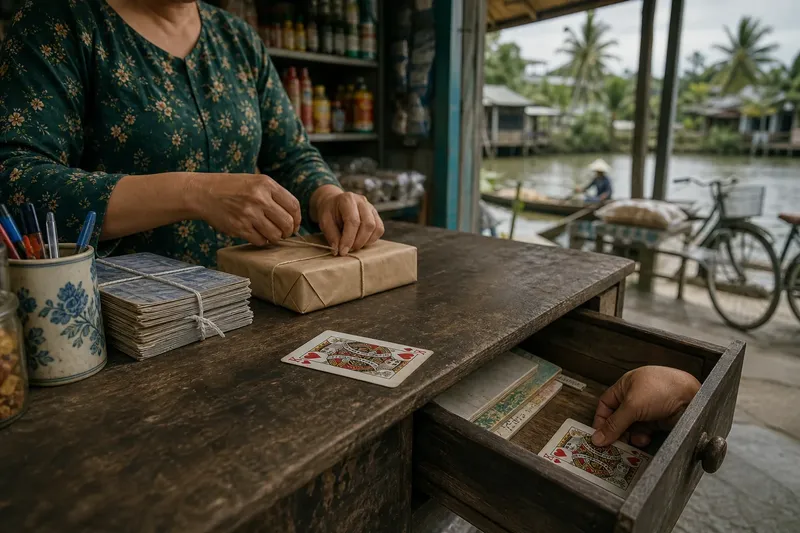
Imagine an invented story set in a small shop in Bến Tre. A character starts with one casino-themed paper card on the counter and one unfinished order to pack. The character uses the card as a marker while sorting the order, then puts it in a drawer after a customer asks about it. The observable result is that the card shifts from visible decoration to a private object; because the order is still unfinished, the story links the motif to a pause in routine, not to a completed change in the character’s work. If the next scene shows the card returning to the counter, read that as renewed display; if it stays in the drawer, read its absence as continued withdrawal.
Questions about objects?
Does every casino object become a motif?
No. A single card or chip may remain a detail unless the story gives it a meaningful role through use, repetition, or consequence. Describe what the text supports instead of assigning symbolic weight automatically.
How does setting affect the image?
Setting creates the context in which an image appears, such as a named street, home, shop, or work activity. Connect the casino detail to those stated surroundings, but do not treat the setting as evidence of actual local casino customs.
What if an object has two meanings?
Keep both readings if each is supported by the scene. A chip may function as a keepsake and as a reminder of risk; explain which details support each meaning rather than forcing a single interpretation.
Can a fictional object document local history?
A fictional object can show what a particular story imagines, but it cannot by itself establish local history or customary behavior. For historical claims, use appropriate sources beyond the literary scene.
Keep claims grounded
Casino motifs in Bến Tre stories become easier to read when you track their material form, practical use, and relationship to a named setting. This approach keeps the focus on how an image works inside the story rather than on assumptions about local life.
When the text gives an object no clear purpose, preserve that ambiguity. A card left unexplained may matter precisely because the story has not yet decided whether it is a tool, a token, or only a passing decoration.