Reading the Words on a Casino Poster
Reading the words on a casino poster separates printed details from mood and implication, helping you describe its message without treating promotion as fact.
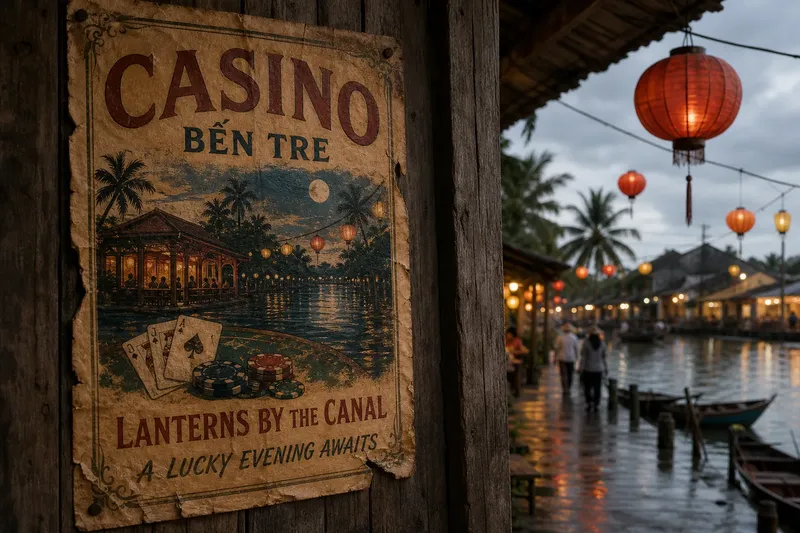
Reading the words on a casino poster means separating its printed details from the mood and expectations it creates. In an invented or archival poster connected to Bến Tre, that distinction helps explain how a few phrases can evoke a place or occasion without documenting what happened there.
Start with the wording you can actually see, then consider its tone and implications. This approach keeps a poster legible as a crafted public message rather than treating its invitation as a neutral account.
Literal details
Copy words that make specific claims: a venue name, event label, date, time, or named attraction. Treat each as something the poster says, not as a verified fact. If a date or location is missing, record the gap rather than filling it with a guess.
Keep the wording intact before paraphrasing it. “Evening tables by the river” evokes a setting, while “tables open this evening” appears to make a direct claim about availability. Punctuation, capitalization, and line breaks can also show which phrase the designer emphasized.
For an archival poster, record uncertainty. A faded word, torn corner, or handwritten addition may make a phrase hard to read; mark it as unclear rather than silently restoring it. For a fictional poster, distinguish what the artifact says from what the surrounding story establishes.
Setting and event
Posters may combine a place description with an invitation. Phrases such as “beside the ferry landing,” “under the awning,” or “near the market road” create a scene, but they do not necessarily explain what happens there. In a Bến Tre setting, a canal or riverside path may evoke familiar geography while leaving the event itself vague.
Ask what each location phrase contributes. It might help readers find a venue, suggest regional identity, or make the event feel rooted in a recognizable landscape. Separating those functions prevents atmosphere from being mistaken for practical information.
Notice whose place is being described. A poster might name a public venue while referring broadly to “the riverside” or “the neighborhood.” Such language can make an event sound communal without explaining who may attend or what access involves.
Mood-setting words
Words such as “lively,” “warm,” “bright,” and “memorable” usually describe an intended feeling, not logistics. They give the poster an emotional tone, but they do not establish what a visitor would encounter.
Read these words alongside nearby nouns and verbs. “A quiet evening of cards” creates a different expectation from “a spirited night of play,” even if neither phrase explains the activities or setting. The wording can frame casino themes as sociable leisure, spectacle, competition, or a backdrop for local storytelling.
Sound and rhythm also shape a poster’s voice. Short phrases, repeated sounds, exclamation marks, and clipped commands can make it seem urgent or festive. Describe that printed effect without assuming the event itself had the same character.
Implied promises
An implied promise is an expectation suggested without a definite outcome or condition. “A night to remember,” for example, points toward a hoped-for experience without saying what would make it memorable. “Fortune awaits” invokes chance and possibility but does not establish an outcome.
Ask what a reader might picture after seeing the phrase, then check whether the poster supplies the details behind that impression. If it suggests welcome, excitement, or a chance to win without stating terms, those ideas belong to its persuasive language, not to confirmed event information.
Calling a phrase suggestive is different from accusing its maker of deception. A close reading can describe the gap between an appealing impression and a stated fact without claiming to know the designer’s motive or the event’s actual conditions.
Audience clues
Pronouns and forms of address help show whom the poster imagines as its reader. “Join us,” “bring a friend,” or “for local guests” can make an invitation sound intimate, social, or selective. They reveal a projected audience, not who attended or who could enter.
Look for references to customary occasions, too. A poster might connect a casino theme to a holiday evening, market day, or village celebration. That wording can draw on seasonal life to make a commercial or fictional event feel related to familiar local rhythms.
Such a reference does not establish that an event belongs to a custom, represents a community, or was accepted by residents. It shows how the poster uses the custom as a point of recognition.
Layout and emphasis
Even when you are reading words, their arrangement affects meaning. A large event name may dominate a small line of conditions, or a date may sit below a decorative slogan. Note which phrases appear first, largest, or most isolated; visual emphasis can make one claim feel more prominent than another.
Compare the headline with any fine print rather than reading only the boldest line. If a practical detail appears in small type while a mood-setting phrase takes up the most space, describe that contrast without inferring more intent than the layout supports.
For a digital image or damaged archival sheet, preserve the original line order in your notes when possible. A phrase split across lines can look like separate claims, while a nearby caption may belong to an illustration. If the relationship is uncertain, say so.
Questions about poster language?
What counts as a factual detail?
A factual detail is a specific claim the poster makes, such as a named place or printed event date. It remains a claim in the artifact until another reliable source confirms it.
How can mood be separated from information?
Ask whether a phrase tells you what, where, or when, or instead suggests how an event should feel. A phrase can do both, so record each function separately when needed.
What makes a promise implied?
An implication invites an expectation without spelling out a definite outcome or condition. Words about excitement, luck, or an unforgettable evening often work this way.
How should unclear wording be handled?
Mark unreadable or ambiguous text as uncertain and preserve the surrounding words. Avoid completing a damaged phrase from context alone, especially if doing so would change the poster’s apparent claim.
A phrase in context
Imagine you are reading an invented poster that says, “Lanterns by the canal, a lucky evening awaits.” Your starting material is just that printed line, with no verified date, venue, or event details. First, record “by the canal” as a location image rather than a precise address. Then treat “lanterns” as a visual or seasonal cue and “a lucky evening awaits” as mood-setting language that implies a hope.
The resulting reading is specific but bounded: the phrase evokes a canal-side atmosphere and suggests luck, while establishing no particular outcome. If another line names a venue or time, add that as a printed detail; it still does not prove what visitors experienced.
Bounded interpretation
A useful reading distinguishes what a poster states, what its language encourages readers to feel, and what it leaves unstated. This is especially helpful when a fictional artifact blends casino imagery with Bến Tre landscapes, seasonal references, or familiar forms of local storytelling.
When describing an archival item, identify it as a poster and say which words are legible; do not turn promotional phrasing into a historical account of local behavior. For a fictional item, keep the interpretation within the invented text rather than treating it as evidence about real residents or customs.
Reading the words on a casino poster carefully also means noticing what the text cannot tell you. A slogan may point toward a mood, place, or hope while leaving the event itself beyond its frame; naming that limit makes the interpretation more precise.